Published 12 December 2025
Swimming Lake Taupō for dementia | mate wareware
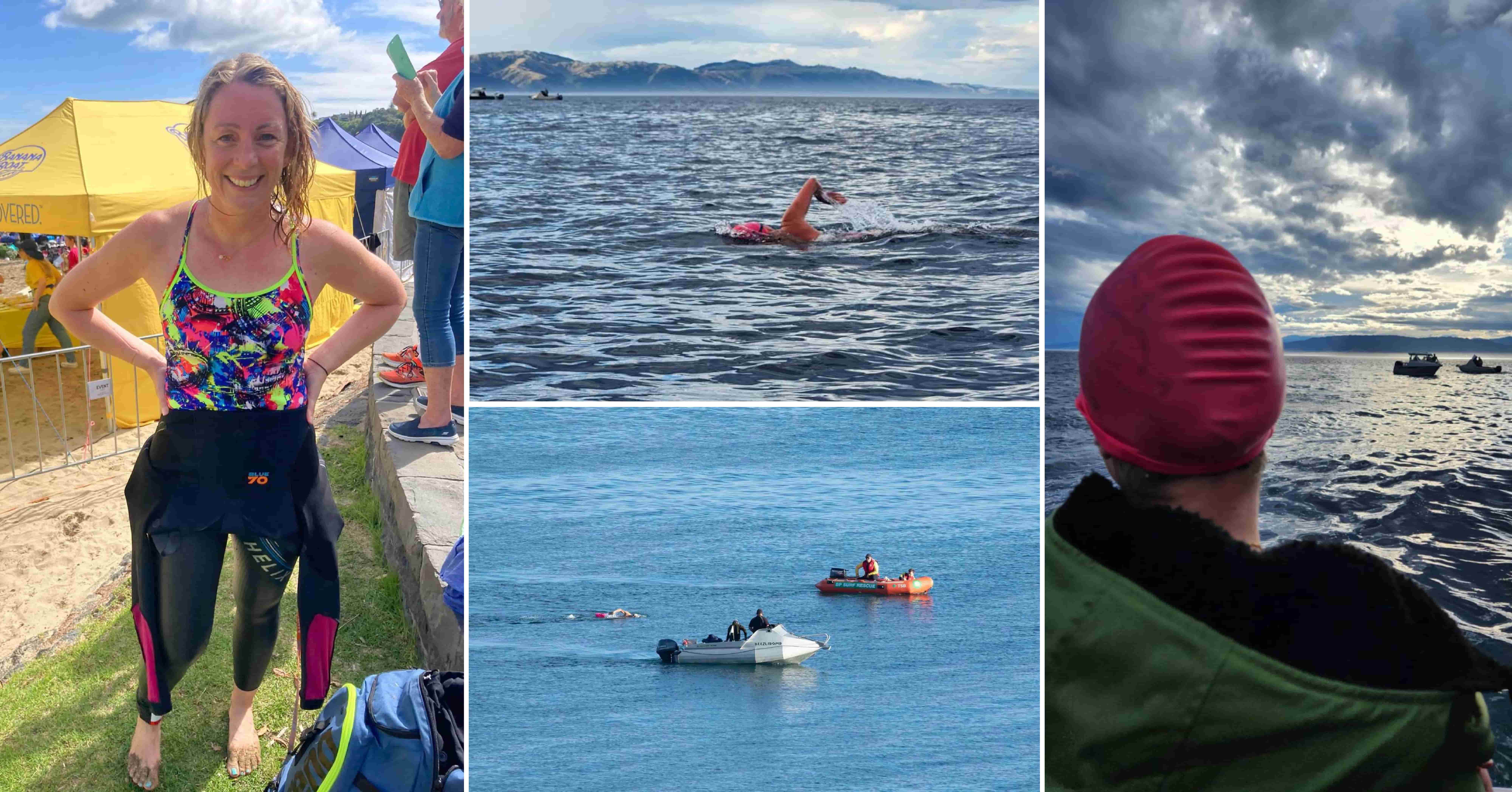
When Danielle Falconer talks about the swim ahead of her, she doesn’t start with the distance or the rules. She starts by saying she wants to do something useful for families who are living with dementia | mate wareware.
The Lake Taupō crossing – 40.2 kilometres, likely 14 to 16 hours of continuous swimming – is simply the vehicle she’s chosen to do that.

Danielle’s motivation is shaped by her own whānau experience. A close family member is living with dementia, and her family has learned how hard it can be to understand what’s happening and find the support you need. She has also seen the impact on people close to her through the experience of long-time family friends who faced similar challenges.
Lorna, who is helping to coordinate the fundraising, knows this path well. Her father, Dave, was supported by Dementia North (covering the Auckland, Waikato and Lakes areas), which is part of the Dementia New Zealand network.
“Our local Dementia Advisor was outstanding,” Lorna says. “She was the guiding light for us when we didn’t know what to do next. She supported the whole family and was always available to guide us through crisis after crisis, from symptoms, doctors, care homes and all the bureaucracy that comes with dementia. We also used the groups and training our local dementia service offered; they were an important part of our journey.”
At Dave’s funeral earlier this year, Danielle saw a smiling photo of him standing on the summit of Mount Kilimanjaro. Seeing the image again stopped her in her tracks.
“It stayed with me,” she says. “I was really on the fence about whether or not to commit to such an ambitious adventure, but seeing Dave’s smile made me realise that I had more to gain by ‘giving it a crack than not.”
That moment made the decision for her. “It felt like a way to support our family, our community, and others who are dealing with dementia.”
Danielle has been swimming long distances for several years, but this was the push she needed to commit to something bigger. She now trains between 10 and 14 hours per week under the guidance of open-water coaches Barb Watson and Phil Rush, mixing pool sessions with time in Wellington Harbour, sometimes in squads and sometimes on her own.
“A swim like this has a lot of variables, so I just focus on what I can control,” she says. “I want to know I’ve done the work properly, so when the day comes, I’ve already achieved my goal and the swim is the icing on the cake – hopefully to be enjoyed.”
Alongside the fundraising, Danielle and Lorna want people to take part in a simple ‘brain-boosting challenge’.
“Not everyone is able to donate,” Danielle says. “But people can still take part. You can do the challenge instead, or as well – it might be 20 minutes of exercise, learning a new word in a different language, or checking in with someone they haven’t spoken to for a while. Anything that supports brain health is valuable.”
The idea is to give people a practical way to support the kaupapa while following her progress.
The swim is planned for mid-February. Two support boats will follow her across the lake, and Lorna will manage updates throughout the day.
“People will want to know how she’s going, and we’ll keep everyone informed,” Lorna says. “You can keep up-to-date with Danielle’s training progress and on-the-day action on Instagram.”
Danielle says the need for clear information and support for care partners and whānau drove her decision to support Dementia New Zealand.
“I thought a lot about where the money should go,” she says. “The journey for families is complex, and it’s hard for people to know how to help. I felt supporting a national organisation was the right place to strengthen education, advocacy, and guidance for whānau.”
We’re grateful to Danielle for taking on this challenge and for choosing to support our mahi, and we appreciate the many people who are backing her along the way.
Find out more about Danielle’s adventure: www.swimtaupo.nz
Supporting brain health
About half of dementia cases are linked to factors that can be influenced across a person’s life. Practical steps that support brain health include:
- Staying socially connected
- Looking after hearing and vision
- Managing blood pressure and cholesterol
- Keeping physically active
- Not smoking and moderating alcohol intake
- Getting support for low mood or depression
More information on reducing brain health risk is available here.