Published 2 May 2026
A Daughter’s Experience of Young Onset Dementia
Fiona Faithfull remembers her mum, Carol, as intelligent, a community leader, and the most patient, unjudgmental mother. But when Carol developed young onset dementia, everything changed.
“Mum had a successful career starting at what was then DSIR [Plant and Food Research, a Crown Research Institute]. Later, she set up a business with Dad, introducing New Zealanders to dwarf citrus trees, supplying nurseries and orchards throughout Aotearoa,” said Fiona.
Carol was one of those hands-on mums, heavily involved at school and in the community. At one point, she was president of Plunket in the Far North, chair of the PTA at Kerikeri Primary School (where her four children attended) and was always active on school camps and sports.
Fiona remembers: “She was so patient and level-headed – I never heard her yell. I think the worst thing she ever said to me as a teenager was that she was ‘really brassed off’ following me smashing a window with a football!”
The first signs of dementia
In her late 40s, Carol began to struggle with what doctors described as a mix of anxiety, depression and that ‘cover-all ailment’, menopause.
“Something clearly wasn’t right – our normally vivacious, outgoing mum was lacking confidence and was withdrawn,” said Fiona.
After searching for answers, Carol was eventually diagnosed with Alzheimer’s disease at the age of 53, a diagnosis she was never capable of accepting or understanding.
“Mum was unable to acknowledge or believe her diagnosis, and in many ways, that robbed us of the opportunity to have those conversations you would ordinarily have with those you love before you lose them.
“When we lost my mother-in-law to cancer, we were all able to say our goodbyes. We were able to talk to her about how much we loved her – and in turn, she told us how much she loved us all. In many ways, it made it easier to get closure.
“While Mum became stubborn and determined, I believe that this was due to her cognitive decline rather than a reluctance to accept the diagnosis. We hadn’t come across anyone in support networks who had similar experiences with the inability to discuss the elephant in the room.”
Because it had taken so long to get an accurate diagnosis, primarily due to her age, none of the therapies that would ordinarily be available to people in an early stage of dementia were suitable.
It was clear to the family that Carol’s illness was progressing rapidly and that Fiona’s father would need help caring for her. The decision was made that both Fiona’s parents and her nana (who had been living with them) would move in with Fiona and her husband so they could care for Carol together.
Caring for mum while starting a family
Shortly after, Fiona became pregnant with their first son.
“When my friends had their babies, their mums were there to help and support – but when I had Lachie, I also had to look after mum. My beautiful, patient mum would have moments where she became a whole different person – someone none of us even recognised at times.”
“I’d make her a cup of tea, and she’d look at it in suspicion, demanding to know what it was that I had put in it. She used to say some terrible things – often telling my siblings or Dad about imagined mistreatment or neglect. It was frustrating and
heartbreaking to be constantly painted as the villain, especially when I was doing all I could to help her. I remember feeling so overwhelmed and exhausted.”
Living with increasing needs
Carol also began to have micro-seizures – presenting most commonly as jerk-reflex movements, which caused her to suddenly throw things or fall over, further complicating her care needs.
Eventually, it became clear to everyone that she needed more help than the family could provide.
“Everything became a battle – she became combative and aggressive about everyday tasks, from getting dressed to personal hygiene.”
It was after one more significant seizure that Carol ended up in the hospital, and the decision was made within the wider family that it was time for her to have around-the-clock care.
“It was a decision that I knew I would never be able to make and something I had asked my sister to take on; she did a great job of stepping in at the right time. As Mum was moved to a home straight from the hospital, we weren’t able to take our time to place her in a care home near our home, as they had no space – simply because we had ignored the probability that an event such as this would dictate the move to care. We had planned which home we wanted her to go to, but we didn’t plan the timing well.
“It’s not something you want to think about, but I feel we cared for her as long as we could, and in the end, she needed more than we were able to provide. As Mum’s daily needs increased slowly over time, how much weight we were carrying really only became evident to us when she was admitted to hospital and we had a real break from her 24-hour care.
“Another difficulty in placing her into care was that mum was still so young and physically capable, and this had always been a roadblock for us. In the end, her illness had progressed so far that by the time she moved into care, her age didn’t carry the weight we thought it would.”
Saying goodbye too soon Carol passed away in 2022 at the age of 61. She is deeply missed by all of her family, and her memory is kept alive with photographs, stories, and a special bench seat along the Waipu River.
“Mum’s favourite tree is a Tibouchina – it has huge bright purple flowers. Dad found a miniature version of it that’s just been released – it’s called ‘Carol Lyn’, just like mum – so the bench seat is now surrounded by beautiful flowers and her own
Carol Lyn.”
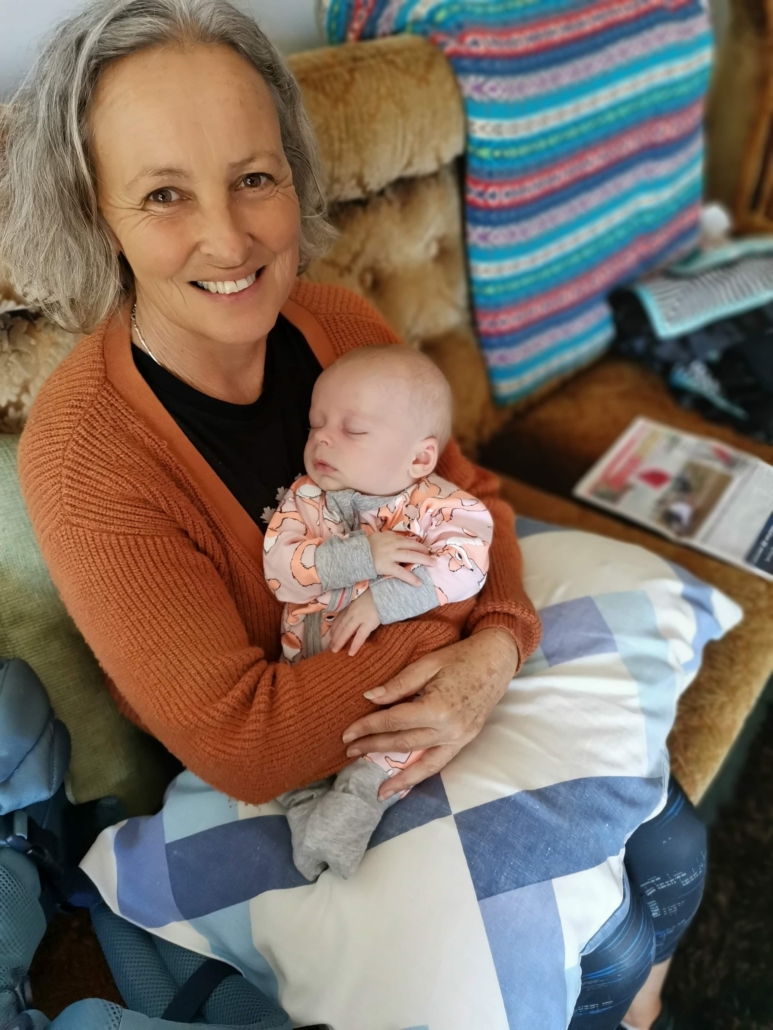
Fiona is telling her story as a way of sharing with others that dementia, and in particular, young onset dementia, can look very different to what people might expect, and that it is often misunderstood. She also wants other care partners to know they are not alone in the challenges they face, and that support and understanding are available.
“If there’s one thing I’d say to others, it’s that you’re doing a good job. You might not feel it at the time, but the love and effort you put in may not feel appreciated, but it matters more than you know.”
Fiona is a lawyer at McVeagh Fleming. Her experience has shaped not only her family life but also her professional one. She is providing subsidised legal support (wills and Enduring Powers of Attorney) for people living with dementia and their whānau.