No one should face
dementia | mate wareware alone.
Earlier diagnosis can lead to earlier support. Earlier support helps people live well.
Dementia | mate wareware is not a disease in itself. It's an umbrella term for around 100 different conditions that affect the brain. Alzheimer's disease, first identified in 1907 by the German doctor Alois Alzheimer, is the most common of them. It isn't a normal part of ageing, and it isn't something anyone has to face alone.

Ki kōna tāua hui ai
Meeting people where they are, wherever they are on the journey.
Find support close byAbout World Alzheimer's Month
The earlier you know, the more you can do
Every September, World Alzheimer's Month unites Alzheimer's and dementia associations across the motu and around the world, alongside everyone involved in treatment, care and support, to raise awareness and challenge the stigma that still surrounds dementia.
This year's theme is exactly why Dementia New Zealand is using this month to show what comes next. Earlier diagnosis can lead to earlier support, and earlier support helps people live well.

Dementia New Zealand and our local Affiliates share information, events, and support throughout the year. Follow Dementia New Zealand on Facebook, Instagram and LinkedIn, and connect with your local Affiliate here.
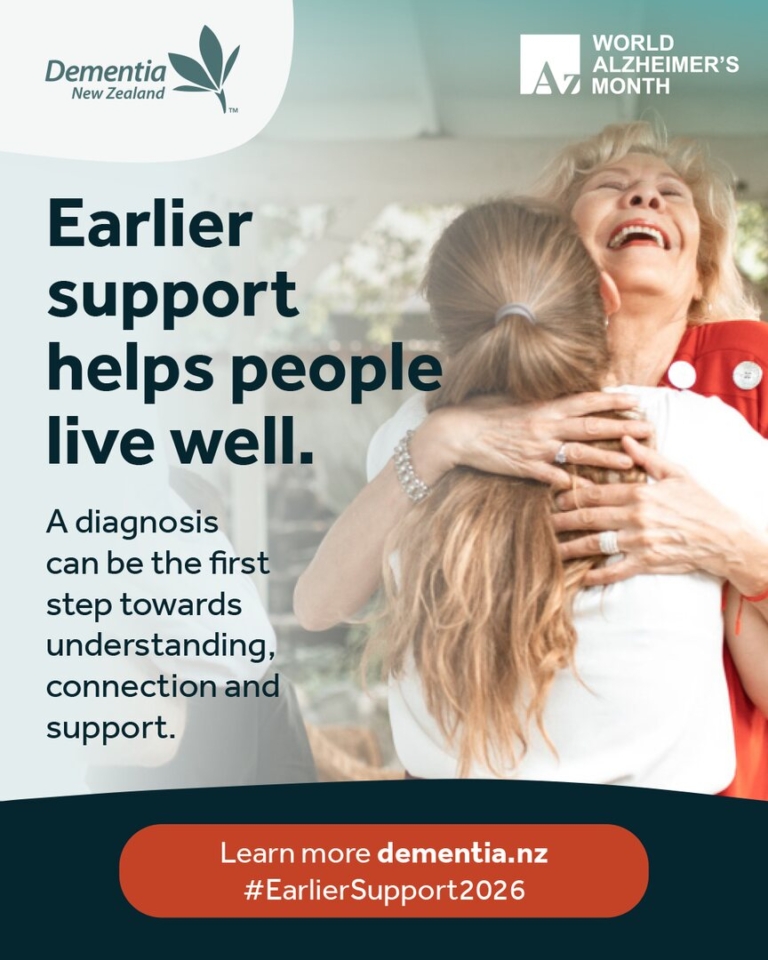
The earlier you know, the more you can do
Wherever you are on the journey, there is support
Whether you are noticing the first changes or years in, there is a next step. Pick the one that sounds most like you.
The journey
Everyone's journey looks different
A dementia diagnosis matters, and the journey does not begin or end with it. It begins with noticing something, and it keeps going long afterwards. This video follows one path from that first change through to living well with support alongside you. Yours will look different, and that is alright.
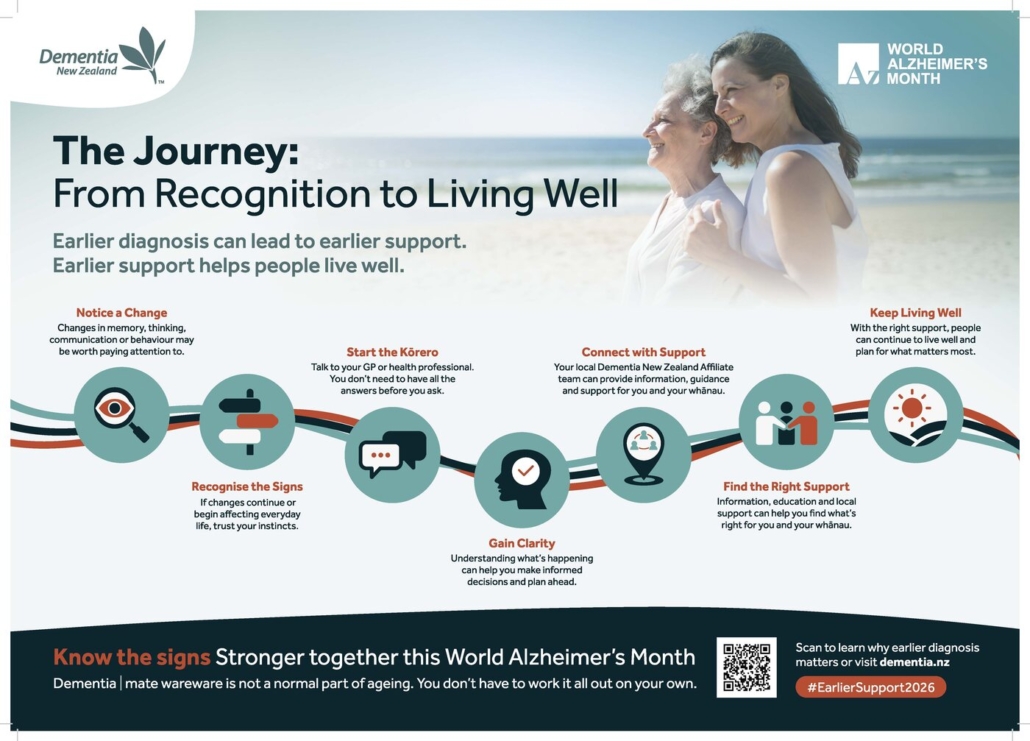
- Notice a change
- Recognise the signs
- Start the kōrero
- Gain clarity
- Connect with support
- Find the right support
- Keep living well







One journey, from the first change through to living well.
Earlier support helps people live well
The Journey: from recognition to living well
The journey is not a straight line, and no two look the same. This poster shows the parts of it people tell us matter, so you can find where you are and see what support sits alongside you.
You are welcome to print it and put it up. Waiting rooms, staff rooms, community noticeboards, the fridge at home, anywhere a kōrero might start.
Download the poster PDF, opens in a new tabStep one of the journey
Notice the signs. Start the kōrero.
Every journey above begins in the same place, with someone noticing that something has changed. Changes in memory, thinking, communication or behaviour are not always easy to spot at first, and they are worth talking about.
Already have a diagnosis? Go straight to the resource hub or read stories from people living well
-
Notice a change
Something isn't quite right. Trust your instincts and look for the early signs.
Signs of dementia -
Talk to your GP
Your GP can help you understand what's happening and discuss what to do next.
Getting diagnosed -
Gain clarity
A diagnosis brings clarity, and clarity brings choice, information and support.
After a diagnosis
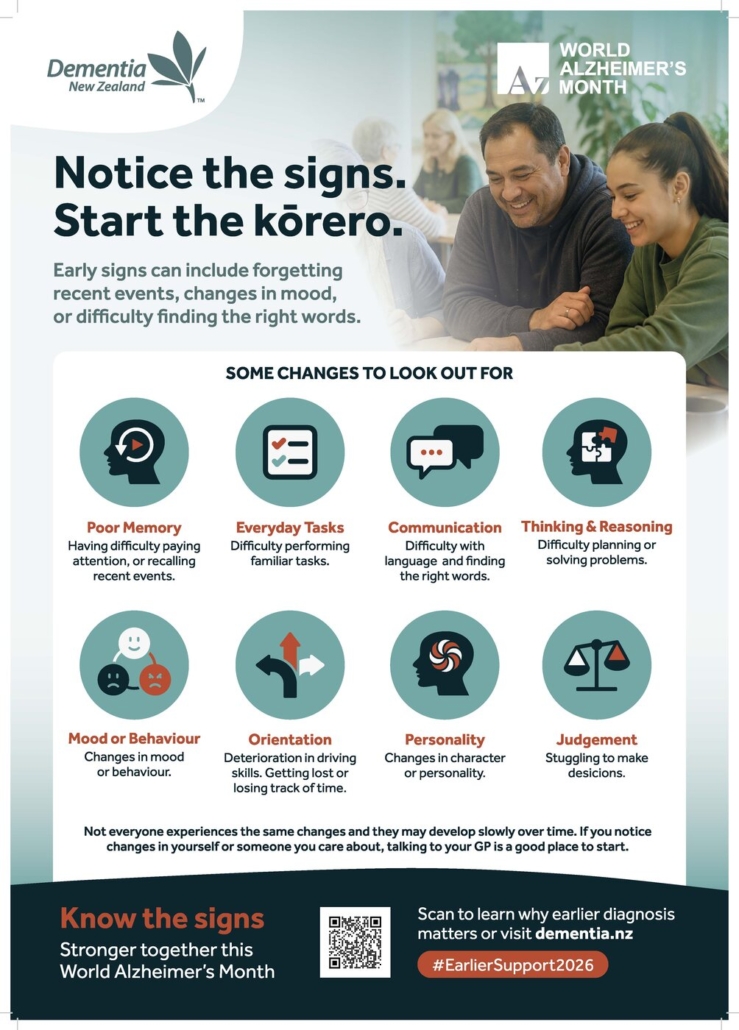
Know the signs
Some of the changes to look out for
Not everyone experiences the same changes, and they can develop slowly over time. Seeing them written down makes them easier to name, and easier to raise with your GP or with someone you care about.
You are welcome to print it and put it up wherever people will see it, at work, in a waiting room, or at home on the fridge.
Download the poster PDF, opens in a new tab Read more about the signs

Earlier diagnosis
A diagnosis brings clarity, and clarity brings choice.
A diagnosis can open the door to information, support and planning for what comes next. If you're already living with a diagnosis, that clarity and choice doesn't stop on day one. It keeps opening doors as things change.
Read more
Understanding Alzheimer's disease: diagnosis, timing and what it means for families

Dementia Navigator
A free online learning tool, at your own pace
Self-paced modules for people living with dementia, care partners and whānau, covering everything from what dementia is to planning ahead, whether that's the week of diagnosis or six months on.
Explore Dementia Navigator
Support, close by
We're here to help you and your whānau
Whether you're a partner, a friend, or family supporting someone from a distance, you don't have to work it out alone. Your local Dementia New Zealand Affiliate, in Tai Tokerau, Auckland, Waikato, Lakes, Tauranga, Hawke's Bay, Wellington and Canterbury, is already walking alongside people in your community.
Find local help
A story from our community
Once the right support was in place, everything changed for our whānau.
Living well
Stories from our community
Dementia changes how someone does the things that matter to them. With the right support, they can still find ways to enjoy them.
It's made him feel connected again.
Jim lives with dementia. When Elizabeth kept asking questions about the changes she was noticing, it turned out not everything was down to dementia. With the right care in place, he is back to the morning paper and watching the birds move through the garden, the parts of the day they had both missed.
-
Carol & Elizabeth: Seeing the Difference
Two Waikato whānau on the value of asking questions when something does not seem right.
Read their story -
It Really Lights Me Up
Carolyn on volunteering with a young onset dementia group in Auckland.
Read their story -

Resource hub
Find what you need, when you need it
Information, support, stories and ways to help, all in one place.

About dementia
Get support
Get involved
Advocacy in action
A future where earlier support is the norm
83,000+
people in Aotearoa live with dementia today, an estimate that's already understood to be conservative. With more than 200,000 whānau affected, that number is expected to more than double within the next 25 years.
Dementia New Zealand is backing the Dementia Mate Wareware Action Plan to help make that a reality.
Stronger together, for everyone living with dementia.