Published 2 April 2026
We could do this here
By Darral Campbell, Chief Executive, Dementia Canterbury
Darral Campbell is the CEO of Dementia Canterbury, which has a multi-modal established young onset dementia service. She is an experienced NGO leader and has spent her career working in social work and allied health-based services in community, Health New Zealand | Te Whatu Ora and university settings.
When dementia is diagnosed before the age of 65, life doesn’t slow down to match the system.
People are often still working. Many have children at home. There are mortgages, friendships, routines, and responsibilities that continue, even as memory, language, or judgement begins to change. Yet the services people encounter are largely designed for a different stage of life.
That mismatch has consequences.
I have worked alongside people living with younger onset dementia (YOD) and their care partners for many years. I have seen how long it can take to get a diagnosis, how often symptoms are misunderstood or minimised, and how hard it is to find support that truly reflects people’s lives. Families adapt, fill gaps, and carry more than they should – not because better support isn’t possible, but because it isn’t organised with them in mind.
In Aotearoa, YOD services remain limited and inconsistent. Where they are available, they’re often short-term, underfunded, or integrated into older persons’ services that don’t suit current needs. The result isn’t just inconvenience; it’s preventable stress, isolation, and wasted time for people who are still very much in the middle of life.
That gap – between what people need and what the system offers – was the starting point for my research.
In 2023, supported by a Winston Churchill Fellowship, I visited services in Canada, Scotland and the Netherlands to examine how other countries organise support for people living with YOD. I wasn’t looking for idealised models. I wanted to understand, in practical terms, what works, what doesn’t, and what could realistically work in Aotearoa.
What I found was clear: better support doesn’t come from a single programme or intervention; it comes from how services are designed to work together over time.
Supporting the whole journey
Across the services I visited, the strongest examples shared one defining feature: they supported people across the dementia journey, not just at diagnosis or crisis points.
In the Netherlands, the Florence Centre for Specialised Care in Early Onset Dementia at Mariahoeve provides a connected pathway that includes community programmes, day support, respite and residential care. People move between these settings as their needs change, while remaining connected to the same specialist team.
That continuity isn’t a luxury. It’s fundamental.
People are not repeatedly assessed by new services or required to re-explain their situation. Relationships, knowledge and trust carry through. Care partners are supported alongside the person with dementia, and children are recognised as part of the picture, not an afterthought.
I met people who attended the community programme several days a week while their partners continued working. Some used overnight respite regularly, which allowed them to remain at home for longer without crisis. Others eventually moved into supported living or residential care on the same site, supported by staff they already knew.
One man told me that without the programme, he would spend most days at home watching television, isolated, while everyone else was at work. Instead, he travelled independently, exercised, socialised, and took part in activities that reflected his age, interests and sense of self.
That difference isn’t marginal; it changes how people experience dementia, day by day.
Where systems fall short
The services I visited in Scotland and Canada also demonstrated good practice, particularly in early post-diagnostic support. Funded link workers, counselling and structured programmes made a meaningful difference for many families in the first year after diagnosis.
What was harder to sustain was continuity over time.
Access often depended on postcode, transport, or personal finances. Once initial support ended, families described uncertainty about what came next. Residential options designed specifically for younger people were limited or unavailable, leaving families to choose between settings that didn’t fit or managing alone for longer than was safe.
Across all three countries, the pattern was consistent. When services are designed for older people by default, younger people and their families are expected to adapt – and many struggle to do so.
That pattern is familiar in Aotearoa.
YOD affects people in the middle of life. It disrupts employment, parenting, relationships and financial security. Care partners often balance paid work with increasing care responsibilities. Children and young people absorb changes that are rarely acknowledged by the system around them.
These realities are well known. What’s missing is a coordinated service response that takes them seriously.
What could – and should – work here
I don’t believe we can simply import overseas models into Aotearoa. Our funding systems, legislation and geography are different. But the principles that underpin effective support are transferable, and the evidence is strong.
International research and current practice support the development of specialist YOD services that remain alongside people and families throughout the dementia journey. A recognised best-practice model exists, and the opportunity now is to adapt this into an Aotearoa context – including the needs of tāngata whenua, Pasifika and other cultures – rather than continuing with ad-hoc or short-term solutions.
From the research, several elements stand out as both necessary and achievable:
- Specialist, interdisciplinary teams with expertise in YOD
- Clear pathways linking diagnosis, community support, respite and residential care
- Continuity of relationships, rather than time-limited interventions
- Age-appropriate environments and activities
- Structured support for care partners and children.
There is a persistent assumption that our population is too small to sustain specialist YOD services. I don’t agree. In major urban centres, there is sufficient population to support designated services if they are intentionally organised and delivered in partnership.
The question is not scale. It’s design.
In the Netherlands, the workforce was predominantly registered and specialist, inclusive of allied health professionals, who remained involved even when people moved into residential care. That approach reduced disruption, improved continuity, and supported families to plan ahead rather than respond to crisis.
It also created respite options that allowed people to remain at home longer, improving the quality of life for both the person with dementia and their care partner.
Elements of this already exist across Aotearoa, within parts of the Dementia New Zealand affiliate network and among other dementia service providers. We’re not starting from zero. What’s lacking is consistency and connection across the wider system, and the confidence to organise services differently where current models no longer fit.
Leadership through collaboration
While a fully co-located model such as Mariahoeve may be difficult to replicate immediately in New Zealand, the findings highlight the importance of engaging early with both Health New Zealand | Te Whatu Ora commissioners and community residential care providers to better integrate specialist YOD services across settings over time.
There is a clear role for Dementia New Zealand and our affiliate network in promoting this discussion alongside the broader dementia community. Some regions have established YOD programmes. Others are eager to do so but encounter challenges. All struggle with with funding, workforce, or infrastructure.
This isn’t about competition between regions or providers. It’s a chance to work together – to define what good support looks like, to share expertise, and to enhance services that are locally delivered and nationally connected.
It also requires collaboration beyond the dementia sector:
- Diagnosis pathways matter. Evidence from the research suggests that diagnosis through neurologists specialising in cognitive disorders can lead to earlier, more age-appropriate diagnosis for people with YOD, and a clearer pathway into specialist support than services designed primarily for older adults. Community involvement/integration in such clinics is pivotal to engagement.
- Residential care providers influence later options. Their role in providing age-appropriate respite and residential care determines whether continuity can be maintained as needs change.
- Funders and policymakers set the conditions. Their decisions determine whether services remain fragmented and short-term or can be organised into more integrated pathways across the dementia journey.
Where services operate effectively overseas, responsibility is collaborative. No single organisation handles the entire task, but progress relies on organisations being willing to work together and lead discussions in their respective roles.
Testing our readiness
I’m realistic about the challenges. Residential care legislation, huge community funding pressures and workforce shortages all influence what’s achievable. Change will require time and needs to be implemented gradually.
At present, designated funding for younger onset dementia services in Aotearoa is limited or absent. Without funding that recognises the distinct nature of YOD, services remain reliant on short-term arrangements or are absorbed into older-person models that cannot deliver continuity across the journey.
However, realism should not turn into inertia.
People living with YOD deserve services that meet their needs now; age should not limit what people are entitled to. Their care partners and whānau deserve support that acknowledges the long, complex journey they are undertaking.
We already know what better support can look like. We have seen it working elsewhere, and we are beginning to build elements of it here.
The question is no longer whether this could be done in Aotearoa. It’s whether we are prepared to organise our services – and our thinking – differently enough to make it happen.
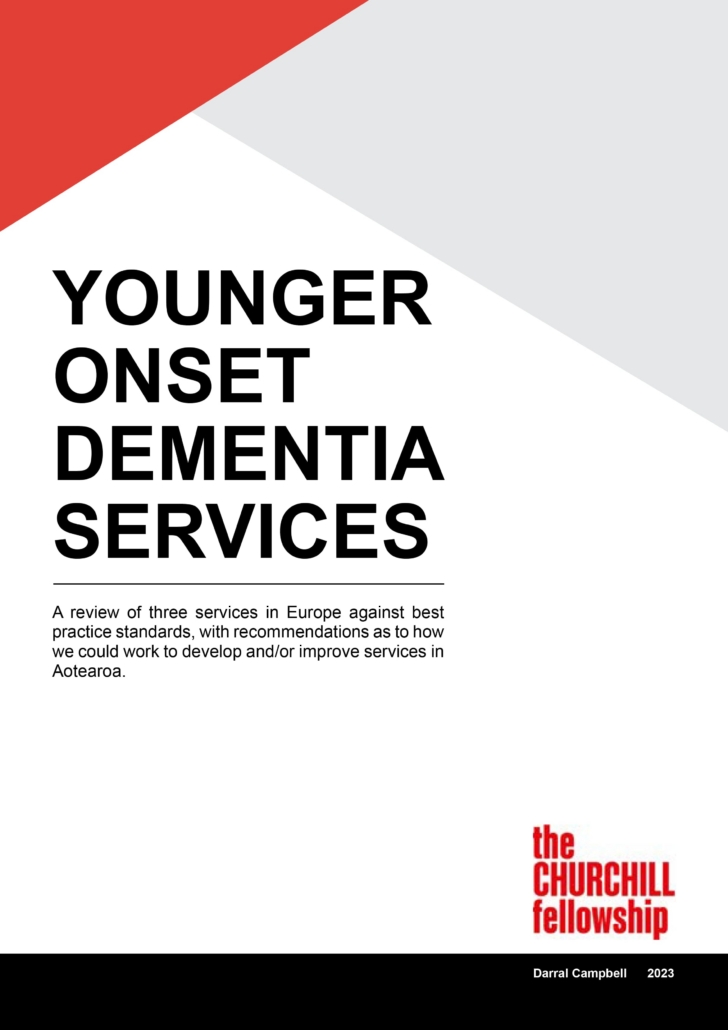
Click here to read Darral’s full research paper.